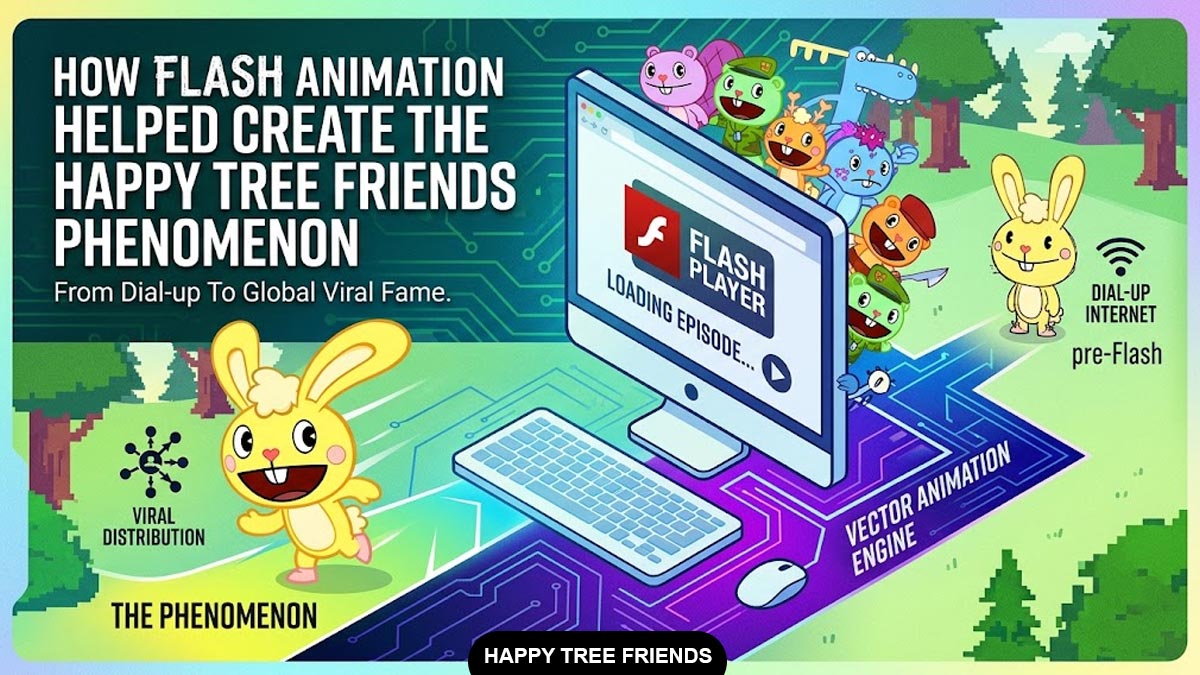
Long before YouTube algorithms, TikTok trends, and social media feeds dominated digital media, internet culture was forged in the wild west of early web animation. In the late 1990s and early 2000s, one specific tool revolutionized how independent creators published video online: Macromedia Flash. And among the wave of creative experiments that emerged, none hit the web with quite the same violent, shock-value splash as Happy Tree Friends.
Created by Rhode Montijo, Kenn Navarro, and Aubrey Ankrum at Mondo Media, Happy Tree Friends wasn’t just a hit cartoon—it was a global phenomenon. But its explosive success wasn’t an accident; it was deeply tied to the rise of Flash technology itself.
The Power of Small File Sizes
In the era of dial-up internet and 56k modems, streaming traditional video files was nearly impossible. Flash vector graphics changed the game by storing shapes, lines, and mathematical paths rather than heavy raster video frames.
This meant an entire two-minute episode of Happy Tree Friends could be compressed down to a tiny file size without losing crispness or resolution. Web users could load and watch an episode in seconds on sites like Newgrounds, AtomFilms, and Mondo’s own web portal—a feat unheard of for standard video formats at the time.
Clean Aesthetics vs. Extreme Gore
Flash’s distinct vector art style inherently produces clean lines, soft geometric shapes, and vibrant color palettes. This tech limitation accidentally provided Happy Tree Friends with its best narrative weapon: deceptive innocence.
The smooth, toy-like Flash visuals made the show look like a preschool educational cartoon. That clean aesthetic heightened the shock factor when the characters were abruptly sliced, crushed, or impaled. Flash allowed the creators to execute hyper-detailed, frame-by-frame gore effects with smooth, mathematical precision, turning slapstick violence into an art form.
Democratizing Global Distribution
Before Flash, getting an animated show onto television required massive studio backing, network approval, and millions of dollars. Flash bypassed the gatekeepers. Mondo Media was able to produce episodes rapidly with a tiny team and distribute them globally to millions of viewers overnight.
Happy Tree Friends proved that independent, edgy content could build a massive international fanbase purely through web-based word of mouth. The show eventually expanded into TV broadcasts, video games, and official merchandise—all originating from simple vector files drawn in Flash.
The era of Flash player software may have officially ended, but its legacy lives on. Happy Tree Friends remains one of the most defining examples of how a single piece of software democratized creative animation and birthed modern internet viral culture.